Why Pharmacology Actually Matters: A Real-Talk Guide for Student Nurses
Let’s be honest: pharmacology can feel like learning a foreign language. But understanding why we give what we give isn’t just about passing university exams—it’s the ultimate safety net for your patients.
The Foreign Language of the Wards
If you’ve ever sat at your desk late at night staring at a massive list of drug classes, half-lives, mechanisms of action, and confusing trade names, you’ve probably asked yourself: When am I ever actually going to use this on a busy hospital ward?
Trust me, I get it. When you’re deep in university lectures, pharmacology can feel completely abstract—like an endless memory test designed purely to stress you out before an exam. But the absolute second you step onto a hospital placement and put on your student uniform, everything shifts. You realize very quickly that pharmacology isn’t just an academic hurdle to cross; it is the silent, invisible safety net protecting your patients during every single shift.
Nobody expects you to walk onto a ward as a first-year, second-year, or even a newly qualified nurse knowing every single medication inside the British National Formulary (BNF). That is completely impossible, and anyone who tells you otherwise has forgotten what it’s like to be in your shoes. What *is* expected of us, however, is a deep respect for how powerful these drugs are, and the curiosity to always look closer when something doesn’t feel right.
The Hidden Danger of Crushing Medications
Let’s look at a scenario that happens on medical and elderly care wards every single day. You’re caring for a patient with dysphagia—swallowing difficulties—who is refusing their morning tablets. It feels like common sense and kindness to want to crush the pill up and mix it into a spoonful of yoghurt or orange juice so they can get their medicine safely.
But this is where a lack of pharmacology knowledge can catch you off guard with devastating consequences.
Many tablets aren’t just simple powders compressed together. They feature specialized engineering, like enteric coatings designed to protect the stomach lining from harsh chemicals, or modified-release (MR) mechanisms built to drip-feed the medicine into the bloodstream slowly over 12 to 24 hours. If you crush an MR tablet without checking, you destroy that protective mechanism entirely. Instead of a steady, safe release, the patient gets hit with a massive, toxic overdose surge all at once, followed by rapid therapeutic failure for the rest of the day. Knowing *why* a drug is shaped or formulated a certain way matters just as much as knowing what the drug is supposed to treat.
Knowing When to Stop: Catching Contraindications
One of the most terrifying yet empowering realizations on placement is that **you are the final safety barrier** between the prescription chart and the patient. Doctors are brilliant, but they are human, exhausted, working across multiple wards, and they don’t always see the patient’s immediate, changing bedside condition.
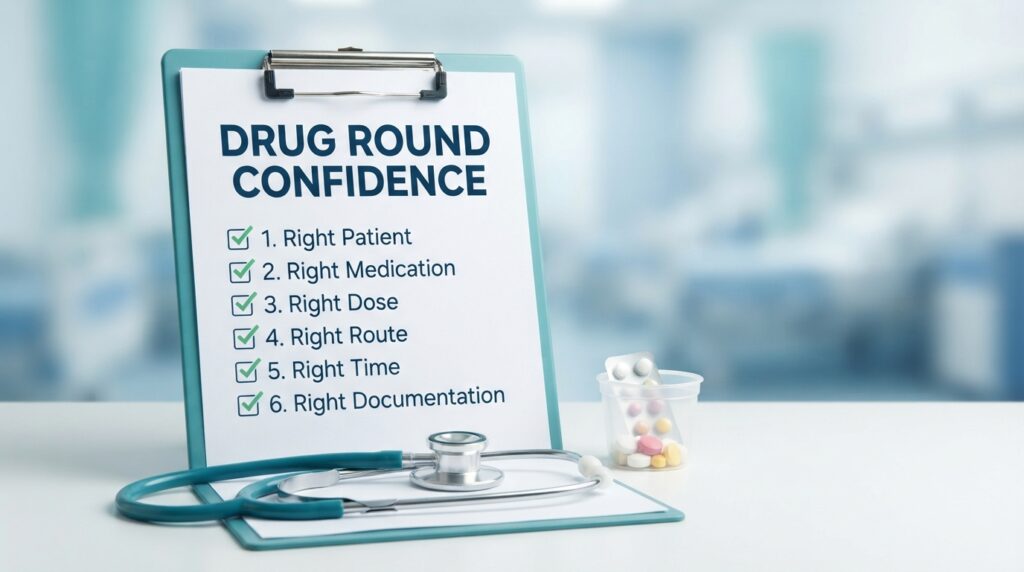
Pharmacology gives you the clinical confidence to pause a drug round and question a chart when parameters don’t match reality:
- Calcium Channel Blockers and Low Blood Pressure: Imagine walking into a bay to give a patient their regular routine blood pressure medication. You pick up the cuff, check their vitals, and find their blood pressure has plummeted or they are sitting up feeling dizzy and bradycardic. If you blindly follow the chart without checking your pharmacology, giving that calcium channel blocker or beta-blocker could crash their blood pressure into a dangerous trough, leading to a fall, syncope, or a medical emergency.
- Short-Acting Insulin and Low Blood Sugar: Picture another common ward moment: it’s time for lunch, and you go to administer a rapid-acting subcutaneous insulin like Novorapid. But when you check their capillary blood glucose, it’s already sitting low or dropping fast. If you administer that insulin without holding it and escalating, you are actively driving their blood sugar down into severe, life-threatening hypoglycaemia.
Your eyes, your hands, and your growing pharmacological understanding are often the only things standing between a routine medication round and a catastrophic clinical incident.
You Don’t Have to Know Everything Alone
It is completely normal to feel overwhelmed by pharmacology. The stakes feel massive because they *are* massive. But building this knowledge isn’t about trying to memorize an entire medical dictionary overnight. It’s about building a daily habit of curiosity, always keeping the BNF app open on your phone or workstation, and never letting fear stop you from asking questions.
If a drug name looks unfamiliar, if a dose looks unusually high, or if a patient’s observations don’t match what’s written on the chart, stop. Talk to your practice supervisor. Speak to the ward pharmacist. Never feel silly for protecting your patient.
You are training to enter one of the most trusted professions in the world. Learning your pharmacology isn’t about ticking a box for university—it’s about earning the confidence to look after your patients safely, day in and day out.
Ready to Master Your Drug Calculations & Wards?
Take the stress out of medicines management and build your clinical confidence today:
Pharmacology – What You Need to Know – The Student Nurse ↗