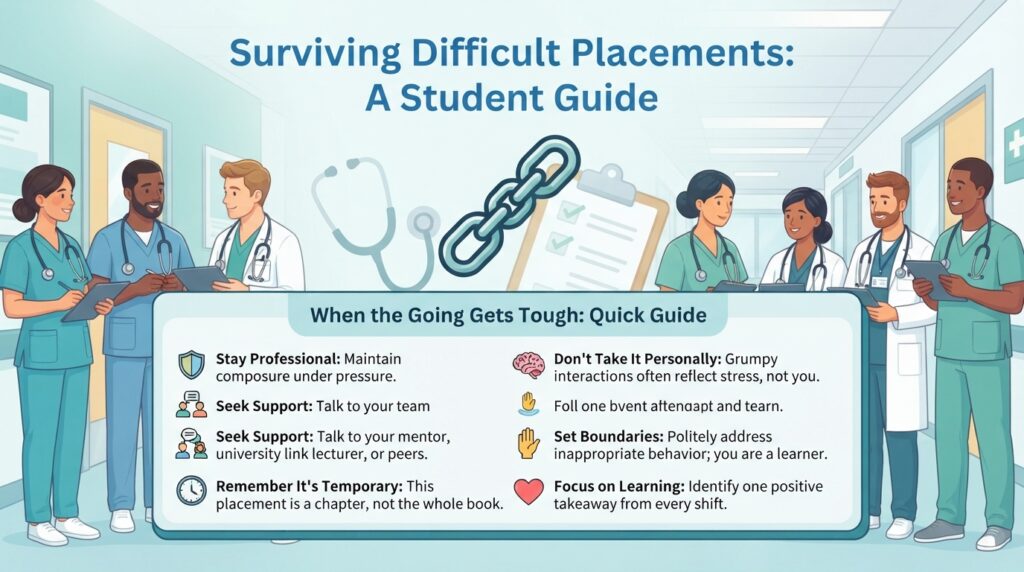
You’ve got your uniform. You’ve read the handbook. You’ve gone over your ABCDE and NEWS2 until you can recite them in your sleep. The night before your first placement, you’ll lie awake running through checklists. You’ll wonder if you’re ready. And here is the honest answer: no one is ever truly ready — but you are more prepared than you think.
I wasn’t a “born nurse.” I started as a catering assistant on a ward in Yorkshire. I watched the nurses — how they moved, how they spoke, how they knew things that weren’t written down anywhere. When I got the chance to train, I thought once I knew the theory, the rest would follow. It didn’t — not in the way I expected anyway. The first day on placement? I felt like I was pretending to be a nurse. I got lost. I forgot basic things. I went home and thought, “Have I made a terrible mistake?”
If that sounds familiar, keep reading. You’re not alone. And what you’re feeling isn’t weakness — it’s what happens when you care enough to want to do it well.
The Gap Between Lecture Hall and Ward
In university, everything is neat. Scenarios are scripted. Mannequins don’t get tired, confused, or upset. They don’t have families asking difficult questions. They don’t refuse care because they’re frightened. On the ward, every single patient is different — and every single shift is unpredictable.
What they don’t teach you in lectures is that the most important skills aren’t in the textbooks. They’re things like:
- Walking into a room and instantly reading the atmosphere — before anyone says a word
- Knowing when a patient is saying they’re fine when they’re actually in pain
- Speaking up confidently to a senior nurse when you’re worried — even though your voice is shaking
- Holding it together when everything feels overwhelming, then finding a quiet moment to breathe
- Leaving work at the door — because if you carry every hard moment home with you, you won’t last
These aren’t things you can learn from a slide deck. They’re things you learn by being there — by watching, trying, getting it wrong, and trying again. And that takes time. Be patient with yourself.
What Actually Happens Those First Few Days
Let’s be real about what you’ll actually experience, because no one should walk into this blind.
Day One: The Overload
You’ll be shown around. You’ll be introduced to what feels like 50 people. You’ll nod and smile and immediately forget every single name. You’ll be shown where things are kept — the drug room, the linen cupboard, the sluice — and by the afternoon you’ll be lost again. This is normal. The layout of a ward is complex. It takes days, sometimes weeks, to truly know your way around.
You’ll hear terms you vaguely remember from lectures but can’t quite place. You’ll see people communicating in short, sharp sentences that don’t make sense to you yet. Write them down. Ask what they mean. Every nurse you admire did exactly the same thing.
Days Two to Five: The Realisation
By the second or third day, the novelty wears off. You start to see how hard the work actually is. You notice how short-staffed the team is. You see how much gets done by people who are already tired. You might feel small — like you’re adding to the workload rather than helping.
Here is the truth: having you there matters. Even if all you do is hold a hand, fetch a glass of water, or listen to a patient who’s been lonely all day — that is nursing. That is the part machines can’t do. Don’t underestimate the value of simply being present.
The First Few Weeks: Finding Your Feet
Around week two or three, things start to click. You recognise routines. You know where the basic things are kept. You start anticipating what your mentor might need before they ask. You still don’t know everything — far from it — but you stop feeling like you’re on completely foreign ground.
This is also when you might hit a wall. The early excitement fades and the reality of how much there is to learn sets in. You’ll question whether you’re capable. Whether you’re clever enough. Whether you’ve chosen the right path. Every single student nurse goes through this. It doesn’t mean you’re in the wrong job — it means you’re growing, and growing is uncomfortable.
What Your Mentor Actually Expects From You
Students often ask me, “What do they want from me?” The honest answer might surprise you.
Your mentor does not expect you to know everything. They do not expect you to work at their speed. They do not expect you to be perfect. What they do hope for is:
- Willingness to show up: On time, rested, ready to try. Even on the hard days.
- Honesty: If you don’t know, say so. If you make a mistake, tell them. Covering things up is dangerous — speaking up is brave and safe.
- Curiosity: Ask why. Ask how. Show you want to understand, not just copy what others do.
- Kindness: To patients, to colleagues, and to yourself. This is the most powerful tool you have.
- Consistency: Small steady efforts beat big bursts followed by burnout. Turn up, do your best, repeat.
I’ve mentored many students. The ones who thrived weren’t always the ones with the highest grades. They were the ones who were honest, who cared deeply, and who kept showing up even when it was hard.
Practical Survival — What Actually Helps
Here is what I wish someone had told me before I started.
The Notebook — Your Best Friend
Carry a small notebook everywhere. Write down:
- Names of staff and their roles
- Where things are kept and how systems work
- New words, abbreviations, and phrases you hear
- Questions to ask later — don’t be afraid to say, “Can I write that down so I remember?”
- Things you want to look up in your own time
This isn’t cheating — this is building your own personal ward manual. Every experienced nurse still carries one. You’ll never outgrow it.
Pacing Yourself — Safe Beats Fast
You’ll see others moving quickly and feel you should match them. You won’t — not yet — and that is okay. Rushing causes mistakes. Rushing makes you miss the subtle signs that keep patients safe. Move steadily. Double-check. If you’re unsure, stop and ask. Being slow and safe is always better than being quick and sorry.
Looking After Yourself — It’s Not Selfish, It’s Essential
Your first placement will take more out of you than you expect. Your brain is doing heavy lifting — processing new information, new emotions, new ways of being. When you go home, you won’t always have energy to study. That is not laziness — that is recovery. Sleep well. Eat properly. Do something that has nothing to do with nursing. You cannot pour from an empty cup.
If you are struggling — and many of you will be — speak up. Your university has support. Your practice supervisor has a duty to listen. And you have every right to say, “This is harder than I expected and I need help.” That is not failure — that is professional responsibility.
The Moment It Clicks
Sometime in those first few weeks, something will shift. You’ll notice a small change in a patient before anyone else mentions it. You’ll speak to someone who’s frightened and realise you’ve helped them feel a little calmer. You’ll contribute to a handover and be listened to.
These moments won’t make headlines. They won’t be celebrated with fanfare. But they are everything. They are proof that you belong here — not because you know everything, but because you see people. You care. And you’re learning to show up, even when it’s hard.
You are not expected to be a fully qualified nurse on day one. You are expected to be a learner — and that means stumbling, asking, trying, and growing. Be kind to yourself through this process. You’re doing something incredibly brave. Keep going.
Full Placement Guide
Packing checklists, shift breakdowns, ePAD goals, and what to expect every step of the way.
Read the Full Guide →Written for Your Pocket
Clinical scenarios, handover frameworks, and honest advice to carry with you on shift.
Browse the Books →