How to Deliver Compassionate End-of-Life Care as a Student Nurse
Facing your first palliative patient or holding a dying person’s hand on shift is one of the most profound, emotionally intense moments you will experience on placement. University teaches us clinical pathways, but true end-of-life care lives in kindness, dignity, and gentle advocacy. Here is how to navigate palliative care, support grieving families, and look after your own heart along the way.
“You matter because you are you, and you matter to the end of your life. We will do all we can not only to help you die peacefully, but also to live until you die.”
— Dame Cicely Saunders, Founder of the Modern Hospice Movement
1. The Shift from Curing to Comforting
As student nurses, much of our training focuses on fixing: administering antibiotics to clear infection, performing ABCDE checks to reverse deterioration, or monitoring vitals to ensure stability. But in end-of-life care, the clinical goal fundamentally shifts. We transition from active treatment to holistic comfort, guided by the individual’s wishes, dignity, and peace.
Under the Nursing and Midwifery Council (NMC) Code, we are called to prioritize people and respond compassionately to those in the last days and hours of life. For a student, this shift can feel unsettling. You might wonder: “Am I doing enough if I’m not taking blood pressure or hanging IV bags?”
The answer is an emphatic yes. In palliative nursing, the “small” things—a moist mouth swab, a gentle turn to ease pressure, a quiet environment, or simply sitting in silence so someone does not die alone—become the most vital nursing interventions you will ever perform.
✦ The Core Priorities of Palliative Care (NICE Guidance)
- Symptom Control: Anticipatory prescribing for pain, agitation, nausea, and respiratory secretions.
- Individualised Planning: Respecting cultural, spiritual, and personal dying wishes.
- Communication: Sensitive, honest, and unhurried conversations with the patient and loved ones.
- Holistic Support: Caring for the family’s emotional and psychological well-being alongside the patient.
2. Recognising the Physical Signs of Dying
Understanding physiological changes during the final days and hours helps you anticipate care needs, reassure anxious family members, and advocate effectively with your Practice Supervisor. While every individual’s journey is unique, common physical indicators include:
• Altered Respiratory Patterns (Cheyne-Stokes & Secretions)
Breathing often becomes irregular, shallow, or features long pauses (apnea). You may also hear “retained respiratory secretions” (sometimes referred to as the death rattle). Reassure families that while this sound can be alarming to hear, it rarely causes distress to an unconscious patient. Positioning them on their side and administering prescribed anticipatory medication (such as Hyoscine butylbromide or Glycopyrronium) helps manage secretions gently.
• Changes in Skin Perfusion & Temperature
As circulation slows, extremities (hands, feet, knees) may feel cool to the touch and develop a mottled or bluish/purple appearance. Keep the patient warm with light, comfortable blankets rather than heavy, restrictive bedding.
• Reduced Consciousness & Withdrawal
Patients often sleep for extended periods, become non-verbal, or gradually unrespond. Remind families that hearing is believed to be the last sense to fade. Encourage them to speak gently, play familiar music, or hold their loved one’s hand.
• Decreased Renal & Gastrointestinal Function
Desire for food and fluids naturally diminishes as metabolic needs slow down. Forcing fluids can increase the risk of aspiration or fluid overload. Regular, gentle mouth care using foam swabs, water, or lip balm provides far greater comfort than artificial hydration in the final days.
💡 A Gentle Nursing Reminder
Routine vital signs (like BP or pulse oximetry) are often discontinued in the final hours unless specifically required for symptom evaluation. Continuous cuff inflation or finger probe lights cause unnecessary disruption. Shift your focus from the monitor numbers to observing the patient’s face for signs of pain or tension.
3. Understanding Anticipatory Medications
On NHS wards and in community settings, doctors and nurse prescribers write **anticipatory prescribing charts** when a patient enters their last days of life. These PRN (as required) subcutaneous medications ensure that if distressing symptoms arise, nursing staff can administer comfort care without delay.
As a student nurse observing medication rounds, you will frequently see four key symptom groups addressed:
- Pain Management: Opioids such as Morphine, Diamorphine, or Oxycodone administered via subcutaneous injection or a continuous Syringe Driver.
- Agitation & Restlessness: Anxiolytics or sedatives such as Midazolam or Levomepromazine to ease distress or terminal restlessness.
- Respiratory Secretions: Anticholinergic medications like Hyoscine butylbromide (Buscopan) or Glycopyrronium to reduce fluid accumulation in the upper airways.
- Nausea & Vomiting: Antiemetics such as Haloperidol, Levomepromazine, or Cyclizine.
4. Supporting Grieving Families: What to Say (and What Not to Say)
Communicating with relatives sitting at a dying patient’s bedside can feel intimidating for students. You might worry about saying the wrong thing, worsening their pain, or intruding on private grief.
Remember: **you do not need eloquent or profound speeches**. What families remember most is a calm presence, an attentive ear, and genuine human warmth.
💬 Supportive Phrases You Can Use
🚫 Phrases to Avoid
Avoid cliches like “I know exactly how you feel,” “They’ve lived a long life,” or “Everything happens for a reason.” These can invalidate deep grief. Instead, acknowledge their emotion simply: “This must be so difficult for you, but you are doing wonderfully being here with them.”
5. Performing Last Offices with Dignity
When death occurs, performing **Last Offices** (the post-mortem care of the deceased) is a sacred nursing duty. It is your final act of advocacy and care for that individual.
Always perform Last Offices alongside an experienced colleague or your Practice Supervisor. Work gently, quietly, and with deep respect:
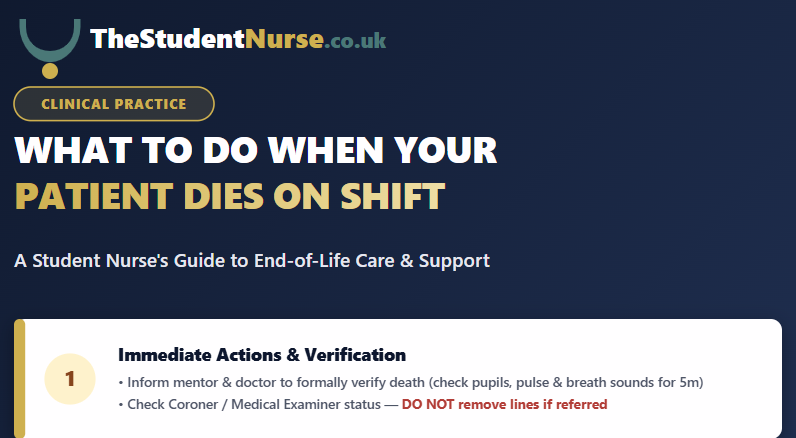
- Check Legal & Coroner Status First: Before removing any IV lines, catheters, or endotracheal tubes, confirm whether the death requires referral to the Medical Examiner or Coroner. If a post-mortem is needed, lines must be left in situ.
- Respect Religious & Cultural Rites: Verify if specific faith requirements exist (e.g., Islamic or Jewish traditions regarding who washes the body or positioning toward Mecca/Jerusalem).
- Wash and Dress with Care: Cleanse the body gently, apply fresh hospital linen or personal clothing requested by the family, insert dentures if appropriate, and lay the patient flat with a single pillow under their head.
- Attach Identification Tags: Complete three accurate identification tags (typically placed on the ankle, wrist, and outer shroud/bag) according to your Trust’s Mortuary policy.
6. Caring for Yourself: Debriefing & Processing Grief
As student nurses, we are often expected to step straight from a room where a patient has died to the next bay to take a set of observations or answer a call bell. This emotional contrast can feel surreal and exhausting.
It is entirely normal to cry, feel shaken, or feel a heavy heart after a patient dies. Compassion is not a weakness—it is the very reason you entered this profession.
💙 Protecting Your Emotional Wellbeing
- Request an End-of-Shift Debrief: Ask your Practice Supervisor or Ward Sister for 10 minutes at the end of the shift to discuss how you feel and process what happened.
- Write a Reflective Entry: Use Gibbs’ Reflective Cycle to record your thoughts in your private journal. Processing the experience academically helps transform grief into clinical growth.
- Reach Out to University Support: If a death triggers personal bereavement or ongoing emotional distress, contact your Personal Tutor or Student Support Team.
- Leave the Shift at the Ward Door: Take a quiet moment on your commute home to consciously step out of your student nurse role and back into your personal life.
Final Thoughts: A Privileged Privilege
Caring for someone at the end of their life is one of the greatest privileges in nursing. Long after a family forgets the exact details of a medical diagnosis, they will remember the kindness, quiet competence, and warm presence of the student nurse who made their loved one’s final hours gentle and dignified.
Be proud of the empathy you bring to the bedside. You are doing important, meaningful work.
Published by TheStudentNurse.co.uk — Dedicated to Supporting UK Student Nurses Through Clinical Practice & Beyond.