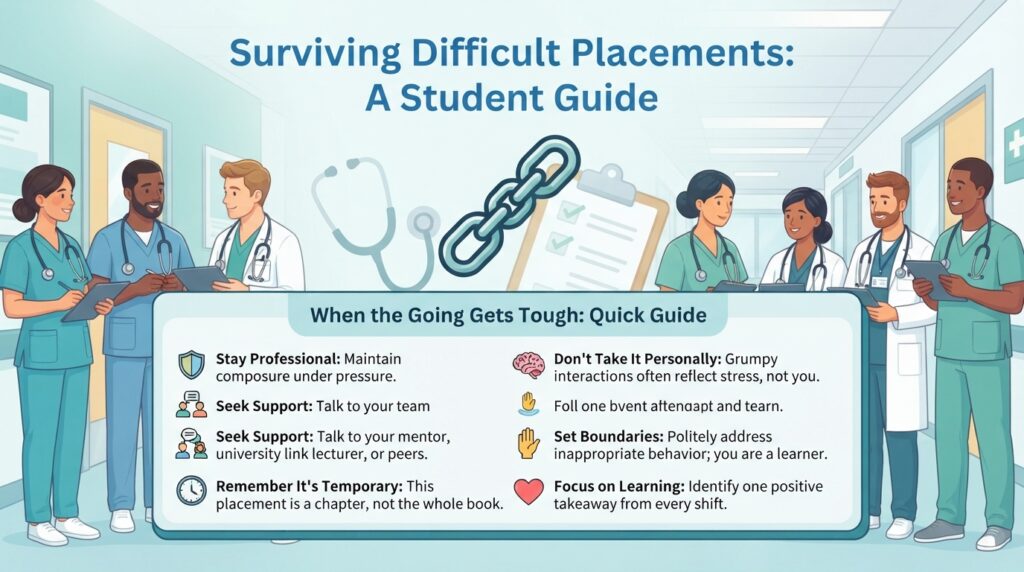
Surviving Placement: Let’s Talk About It.
Let’s drop the polished textbook facade for a second. If you are currently sitting in your uniform, dreading your next shift, or crying in your car before a placement block, I see you.
We need to have an honest conversation about healthcare and student placements. Everyone loves to talk about the rewarding moments, the brilliant mentors who change your trajectory, and the sheer joy of finally connecting theory to practice. But nobody talks enough about how downright soul-crushing a bad placement can be.
If your current placement is making you question your entire career choice, take a deep breath. You aren’t weak, and you aren’t failing—you’re just surviving a broken system.
The Reality Check: Some Placements Are Unsupportive
Let’s be completely candid: some placements are toxic, cold, and entirely unsupportive.
You walk onto a ward or into a clinic hoping to learn, only to find an environment choked by staff shortages, overwhelming workloads, and an exhausted team running on fumes. In the worst-case scenarios, students aren’t treated like learners; they’re treated like a nuisance, ignored by staff, or left to sink or swim without adequate supervision.
Going home with physical exhaustion is one thing. Going home mentally drained, feeling invisible, or dreading the next morning because of a hostile culture is a completely different kind of heavy. If you’ve experienced this, your feelings are entirely valid.
The HCA Trap: When You’re Just a Pair of Hands
Let’s address the elephant in the room: being used as a Healthcare Assistant (HCA).
Look, let’s get one thing straight—basic care matters. Understanding how to wash, feed, and toilet a patient is foundational to clinical practice, and there is immense value and therapeutic connection in those tasks.
But there is a massive difference between learning clinical fundamentals and being used as cheap, unpaid labor to plug staffing gaps.
When you are routinely counted on to make up the numbers, stuck running the bedpan round for eight hours straight without ever seeing a learning opportunity, or told “there’s no time for supernumerary learning today,” you aren’t being trained—you’re being exploited. Your supernumerary status is supposed to protect your education, but all too often, it gets buried under the weight of an overstretched NHS or healthcare facility.
How to Protect Your Energy and Survive
If you’re stuck in a tough placement right now, you don’t have to just suffer in silence. Here are a few ways to claw back some control:
- Document everything: If you are consistently being denied learning opportunities or pushed into a workforce role, keep a private, objective diary of dates, shifts, and specific events.
- Lean on your peers: The students suffering alongside you are your greatest lifeline. Venting to someone who actually understands what “late-early shifts and a 2-hour commute” feels like is vital.
- Protect your boundaries: Do your best, care for your patients with compassion, but remember that you cannot pour from an empty cup. Leave work at the door when your shift ends.
Remember: Help Is Available (If You Want It)
The most important thing to know is that you do not have to endure a horrific placement alone.
It can feel terrifying to speak up because you’re worried it will affect your grade or make you look “difficult.” But you have options:
- Talk to your Personal Tutor or Academic Assessor: Reach out to your university. Good universities have procedures in place to support students through failing or toxic placement areas.
- Contact your Student Union or Professional Body: If you’re a nursing or allied health student, organizations like the RCN or UNISON have helplines specifically for students dealing with workplace pressures and placement exploitation.
- Use University Wellbeing Services: Mental health support isn’t a luxury; it’s a necessity when you’re navigating high-stress clinical environments. Use the counselling or mental health resources your institution provides.
Placements are temporary. They do not define the kind of professional you will ultimately become. Keep your head down, protect your mental health, lean on your support network, and remember why you started this journey in the first place. You’ve got this.